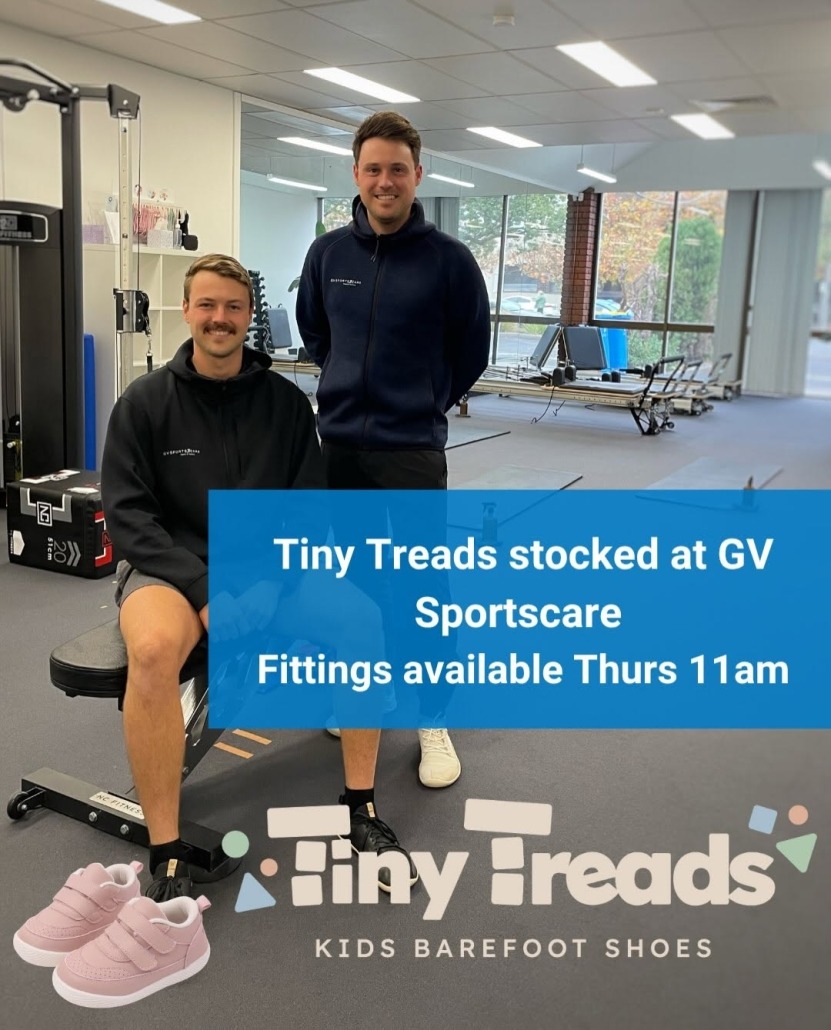
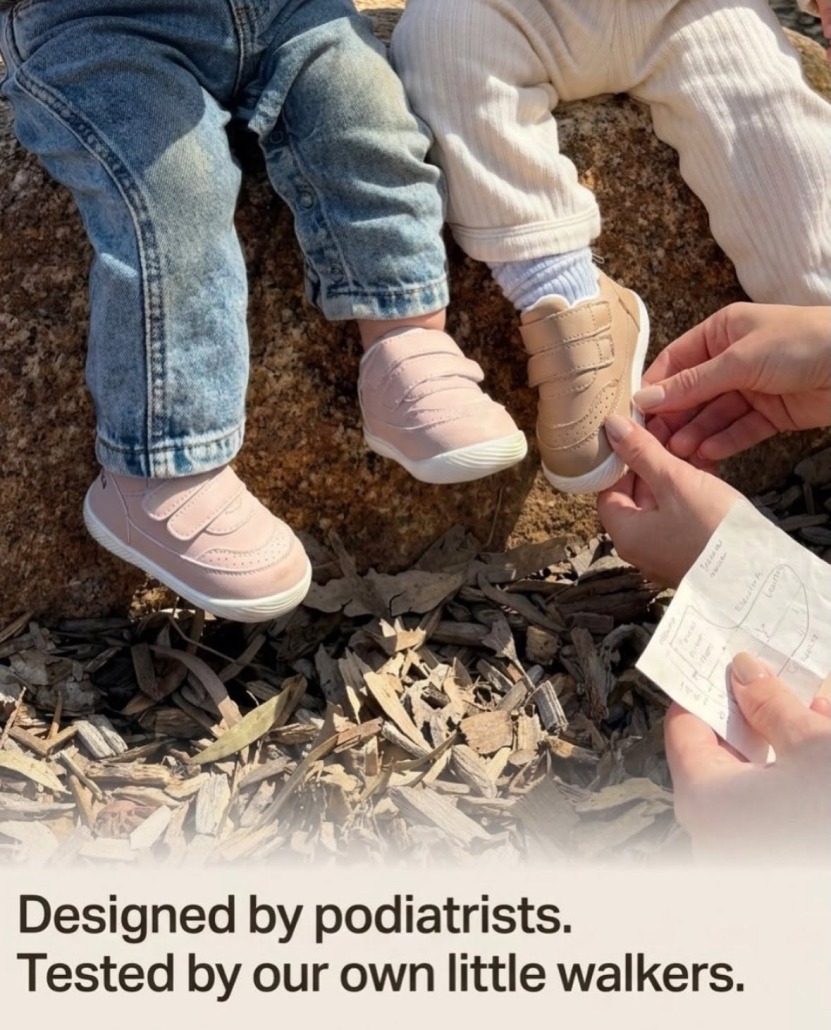
We’re excited to now stock Tiny Treads at GV Sportscare! Barefoot toddler shoes!


You’ve probably heard the term ‘pelvic floor’ thrown around here and there, but what actually is the pelvic floor and why is it important?
The pelvic floor is a group of muscles located in our pelvis that stretch like a sling from the pubic bone at the front of your pelvis to the tailbone at the back of your pelvis, and side to side to each ischial bone (sitting bones).
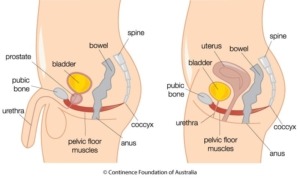
In the simplest terms, the pelvic floor supports the pelvic organs that sit above it and prevents the pelvic organs from falling through. Above your pelvic floor sits your important organs including the bladder, bowel and the uterus, and the pelvic floor muscles help to control release of urine and faeces from these organs by relaxing and contracting muscles around the openings of these organs (sphincters). The pelvic floor also plays an important role in sexual function in both males and females.
Image source: https://www.continence.org.au/about-continence/continence-health/pelvic-floor
Just like any other muscle in your body, the pelvic floor muscles can become weak. This can happen in both females and males! This means that they are unable to support the pressure coming from your abdomen, or cannot control the flow of urine or faeces out of the bladder or bowel.
Some of the signs of this include bladder leakage with coughing, sneezing, laughing, running, jumping, urgency to use your bladder or bowels, or in females, signs of a prolapse including heaviness or pressure or the feeling as though something is coming out of your vagina.
Some people have a higher risk of developing pelvic floor problems:
If you can relate to any of these symptoms, just remember you are not alone. 1 in 4 people (males and females) will experience bladder leakage, 1 in 4 women will experience a prolapse in their life, and 1 in 10 young women will experience bladder leakage during sport – but just because this is common doesn’t mean it is normal!
Physiotherapists are experts in managing musculoskeletal problems, and the pelvic floor muscles are no exception! The research suggests that exercises for your pelvic floor which are done for a minimum of 12 weeks can significantly reduce symptoms of pelvic floor dysfunction, and if started during pregnancy can prevent pelvic floor issues after pregnancy!
Our Shepparton physiotherapists are trained in delivering these exercise programs which we can design for you to complete at home and can make sure that you are completing the exercises correctly. Alternatively, our Clinical Exercise (formerly Clinical Pilates) classes are also designed to target the pelvic floor muscles if this is an issue for you.
If you are worried about your pelvic floor during your regular exercise routine, here are some tips that you can start with to reduce strain on your pelvic floor:
Our Shepparton physiotherapists can assist you to form an exercise regime that is safe for your pelvic floor based on your individual needs. We can also help guide if you need to see a specialist women’s health physiotherapist.
Helpful Websites:
Continence Foundation of Australia
Pelvic Floor First, Pelvic Floor Safe Exercises
Go Against The Flow (support for young women with incontinence)
Physiotherapist Shepparton
GV Sportscare

You’ve probably heard the term ‘pelvic floor’ thrown around here and there, but what actually is the pelvic floor and why is it important?
The pelvic floor is a group of muscles located in our pelvis that stretch like a sling from the pubic bone at the front of your pelvis to the tailbone at the back of your pelvis, and side to side to each ischial bone (sitting bones).

In the simplest terms, the pelvic floor supports the pelvic organs that sit above it and prevents the pelvic organs from falling through. Above your pelvic floor sits your important organs including the bladder, bowel and the uterus, and the pelvic floor muscles help to control release of urine and faeces from these organs by relaxing and contracting muscles around the openings of these organs (sphincters). The pelvic floor also plays an important role in sexual function in both males and females.
Image source: https://www.continence.org.au/about-continence/continence-health/pelvic-floor
Just like any other muscle in your body, the pelvic floor muscles can become weak. This can happen in both females and males! This means that they are unable to support the pressure coming from your abdomen, or cannot control the flow of urine or faeces out of the bladder or bowel.
Some of the signs of this include bladder leakage with coughing, sneezing, laughing, running, jumping, urgency to use your bladder or bowels, or in females, signs of a prolapse including heaviness or pressure or the feeling as though something is coming out of your vagina.
Some people have a higher risk of developing pelvic floor problems:
If you can relate to any of these symptoms, just remember you are not alone. 1 in 4 people (males and females) will experience bladder leakage, 1 in 4 women will experience a prolapse in their life, and 1 in 10 young women will experience bladder leakage during sport – but just because this is common doesn’t mean it is normal!
Physiotherapists are experts in managing musculoskeletal problems, and the pelvic floor muscles are no exception! The research suggests that exercises for your pelvic floor which are done for a minimum of 12 weeks can significantly reduce symptoms of pelvic floor dysfunction, and if started during pregnancy can prevent pelvic floor issues after pregnancy!
Our Shepparton physiotherapists are trained in delivering these exercise programs which we can design for you to complete at home and can make sure that you are completing the exercises correctly. Alternatively, our Clinical Exercise (formerly Clinical Pilates) classes are also designed to target the pelvic floor muscles if this is an issue for you.
If you are worried about your pelvic floor during your regular exercise routine, here are some tips that you can start with to reduce strain on your pelvic floor:
Our Shepparton physiotherapists can assist you to form an exercise regime that is safe for your pelvic floor based on your individual needs. We can also help guide if you need to see a specialist women’s health physiotherapist.
Helpful Websites:
Continence Foundation of Australia
Pelvic Floor First, Pelvic Floor Safe Exercises
Go Against The Flow (support for young women with incontinence)
Physiotherapist Shepparton
GV Sportscare
-Sophie Woodhouse
Physiotherapist Shepparton
GV Sportscare
I know we are all keen beans to get back to sport, but for those fast bowlers amongst us, slow down a second 😉
Adolescent fast bowlers are more at risk of lumbar (lower back) stress injuries and how many balls you bowl per week for your AGE is very important! Now more than any other season we have the potential to overdo it given the lack of sport over winter.
As researched by Cricket Australia: ‘the frequency of bowling sessions (more sessions per week and less time between sessions) increases the risk of developing a lumbar stress fracture. This was a more prominent risk factor than the number of balls bowled’
-Avoid bowling more than 2 days in a row where possible
-Avoid bowling more than 4 days in a week
-Allow one easy week (eg: 50% of target load) every 4-5 weeks
-Schedule a week off bowling after every 10-12 weeks of bowling to allow your body to recover
https://www.community.cricket.com.au/clubs/youth-pace-bowling-guidelines
2019 20 Junior Bowling Guidelines Explained
Any questions or any early concerns of back pain in bowlers, should be addressed by your healthcare professional ASAP!
#shepparton #cricket #sheppartoncricket #bowling #fastbowler #physioshepparton #loadmanagement #gvsportscare #gv #goulburnvalley
Sophie Woodhouse
Physiotherapist Shepparton
GV Sportscare
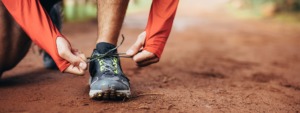
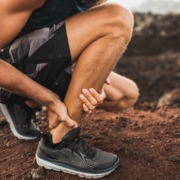
We have seen an increase in running injuries over the past few months in both experienced runners and those new to running.
Shepparton Podiatrist Tom explains in this video how to map out your runs and think carefully about the amount of rest in between each run. He also explains why rest days, strength and conditioning and cross training are all great ideas.
When it comes to running injuries, Tom will often help his clients to write out their weekly routine and look at what can be added or adjusted to allow the individual to continue to run while rehabbing an injury.
Tom Davey
Podiatrist Shepparton, GV Sportscare
As health professionals we have an interest in diet as we believe diet, exercise and sleep to be the most important modifiable factors impacting your health. We first came across the low carbohydrate high fat diet (LCHF) in 2018. We felt an overall improvement in our health, energy levels, weight and sleeping. Since this stage we have gone on to learn more and more about LCHF and how the food industry has lead us astray.
🥑 🌶️ 🥒 🥜 🥓 ☕️ 🥗 🧀 🐟
Dr Peter Brukner, the ‘founder of sports medicine’ in Australia, creator of Olympic Park Sports Medicine, left his lucrative role as sports doctor for Cricket Australia and became a full time advocate to reduce Australia’s sugar intake by half. Sophie was lucky enough to watch him evolve through this process, seeing him lecture on the topic 4 times over a number of years. Peter has joined many other top doctors around the world to look at the impact of high carbohydrate (high sugar) diets on obesity, type two diabetes and overall health. The LCHF diet is essentially returning to how we used to eat, before obesity was rampant and is not a diet so much as understanding what is healthy food and what is not. Learning from science, not from what the food industry markets to us. It is about understanding that starch breaks down to sugar and it doesn’t matter if that is found in your white bread or your banana, it still breaks down to sugar.

We are particularly interested in the LCHF diet as it also aligns with a low inflammatory diet and this can have a large impact on musculoskeletal and arthritic conditions. Excessive weight has been proven to negatively impact your joint health and therefore we find it important to talk about your weight and diet as part of your injury management. It also impacts the health of a diabetic and Dr David Unwin, your friendly local GP from the UK has had huge success with reversing type two diabetes via diet alone (ie drug free reversal of type two diabetes). This again links to Tom’s work as a Podiatrist providing skin and nail care for diabetics who are more at risk of ulcers and sensation/circulation complications. We had the pleasure of hearing Dr Unwin speak and he is a gentle and thoughtful Dr that has changed how he practices and truly listens to his patients. We highly recommend his content, particularly his youtube videos if you are a type two diabetic.
As we are not dieticians or nutritionists we have put together a library of resources to read and learn from. We also have close contacts of people in these industries and can point you in the direction of a helping hand. It’s also important to note that different people have different food tolerances and this will impact what food is right for you. Chose your medium, don’t try to read/listen/watch to them all!

A Fat Lot of Good, Peter Brukner
Good Calories Bad Calories, Gary Taubes
The Big Fat Surprise, Nina Teicholz

Low Carb Downunder, this website also has a list of Australian LCHF health professionals. If you are looking for a particular health professional please feel free to also speak with us.
Fat lot of good: website links, podcasts
Diet doctor: A low-carb diet for beginners
Intermittent fasting for beginners

Dr James Muecke, 2020 Australian of the Year

Dr David Unwin: HOPE on the horizon. Type 2 diabetes.
Dr. David Unwin & Dr. Jen Unwin – ‘Behaviour Change ‘In a nutshell’ & Picking our low carb battles’
Dr David Unwin: Explaining low carb in a simple way

The Fat Lot of Good website has a great list of podcasts
GP Podcast: Low carb for diabetes: Part 1, Part 2
🥑 🌶️ 🥒 🥜 🥓 ☕️ 🥗 🧀 🐟
-Sophie Woodhouse
Physiotherapist Shepparton, GV Sportscare
-Tom Davey
Podiatrist Shepparton, GV Sportscare
Image sources:

Tom Davey
Podiatrist Shepparton, GV Sportscare

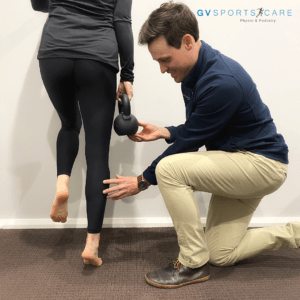
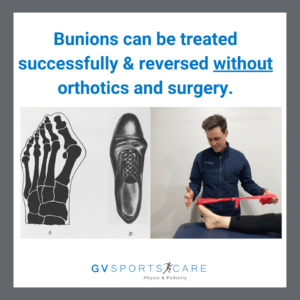
Tom achieves this via foot/leg strength, movement/mobility and footwear selection.
👞
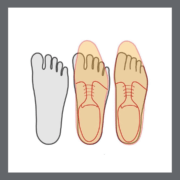
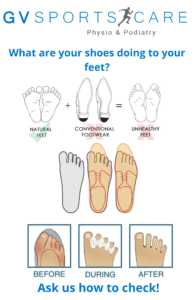
Everyone needs natural foot shape and function to move pain free. Certain features in most modern shoes prevent the foot from functioning as it should.
👣
Building foot and leg strength, increasing mobility within the foot and avoiding particular shoe features can see a bunion return to normal over time.
⏰
Surgery for bunions is necessary in some cases. However, it is important to know that there are treatments and changes that can be utilised to fix or manage the bunion conservatively.
💉

Tom Davey
Podiatrist Shepparton, GV Sportscare