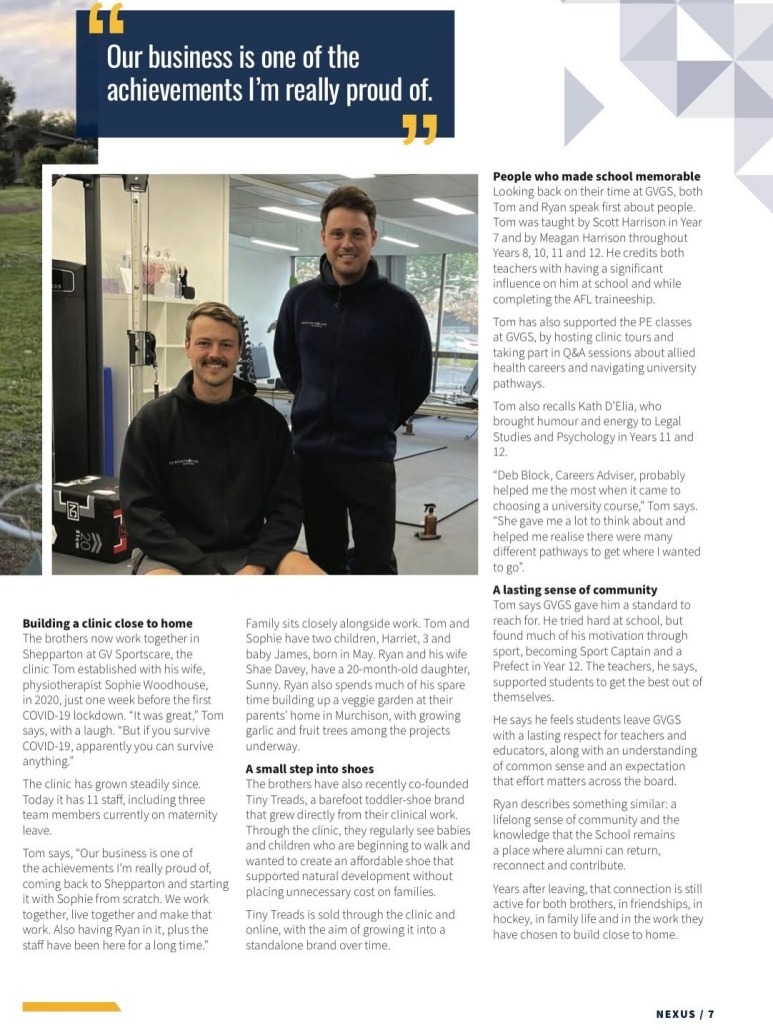
We’re excited to now stock Tiny Treads at GV Sportscare! Barefoot toddler shoes!


You’ve probably heard the term ‘pelvic floor’ thrown around here and there, but what actually is the pelvic floor and why is it important?
The pelvic floor is a group of muscles located in our pelvis that stretch like a sling from the pubic bone at the front of your pelvis to the tailbone at the back of your pelvis, and side to side to each ischial bone (sitting bones).
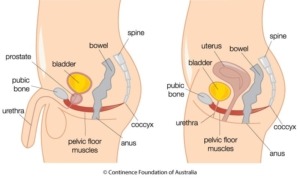
In the simplest terms, the pelvic floor supports the pelvic organs that sit above it and prevents the pelvic organs from falling through. Above your pelvic floor sits your important organs including the bladder, bowel and the uterus, and the pelvic floor muscles help to control release of urine and faeces from these organs by relaxing and contracting muscles around the openings of these organs (sphincters). The pelvic floor also plays an important role in sexual function in both males and females.
Image source: https://www.continence.org.au/about-continence/continence-health/pelvic-floor
Just like any other muscle in your body, the pelvic floor muscles can become weak. This can happen in both females and males! This means that they are unable to support the pressure coming from your abdomen, or cannot control the flow of urine or faeces out of the bladder or bowel.
Some of the signs of this include bladder leakage with coughing, sneezing, laughing, running, jumping, urgency to use your bladder or bowels, or in females, signs of a prolapse including heaviness or pressure or the feeling as though something is coming out of your vagina.
Some people have a higher risk of developing pelvic floor problems:
If you can relate to any of these symptoms, just remember you are not alone. 1 in 4 people (males and females) will experience bladder leakage, 1 in 4 women will experience a prolapse in their life, and 1 in 10 young women will experience bladder leakage during sport – but just because this is common doesn’t mean it is normal!
Physiotherapists are experts in managing musculoskeletal problems, and the pelvic floor muscles are no exception! The research suggests that exercises for your pelvic floor which are done for a minimum of 12 weeks can significantly reduce symptoms of pelvic floor dysfunction, and if started during pregnancy can prevent pelvic floor issues after pregnancy!
Our Shepparton physiotherapists are trained in delivering these exercise programs which we can design for you to complete at home and can make sure that you are completing the exercises correctly. Alternatively, our Clinical Exercise (formerly Clinical Pilates) classes are also designed to target the pelvic floor muscles if this is an issue for you.
If you are worried about your pelvic floor during your regular exercise routine, here are some tips that you can start with to reduce strain on your pelvic floor:
Our Shepparton physiotherapists can assist you to form an exercise regime that is safe for your pelvic floor based on your individual needs. We can also help guide if you need to see a specialist women’s health physiotherapist.
Helpful Websites:
Continence Foundation of Australia
Pelvic Floor First, Pelvic Floor Safe Exercises
Go Against The Flow (support for young women with incontinence)
Physiotherapist Shepparton
GV Sportscare

You’ve probably heard the term ‘pelvic floor’ thrown around here and there, but what actually is the pelvic floor and why is it important?
The pelvic floor is a group of muscles located in our pelvis that stretch like a sling from the pubic bone at the front of your pelvis to the tailbone at the back of your pelvis, and side to side to each ischial bone (sitting bones).

In the simplest terms, the pelvic floor supports the pelvic organs that sit above it and prevents the pelvic organs from falling through. Above your pelvic floor sits your important organs including the bladder, bowel and the uterus, and the pelvic floor muscles help to control release of urine and faeces from these organs by relaxing and contracting muscles around the openings of these organs (sphincters). The pelvic floor also plays an important role in sexual function in both males and females.
Image source: https://www.continence.org.au/about-continence/continence-health/pelvic-floor
Just like any other muscle in your body, the pelvic floor muscles can become weak. This can happen in both females and males! This means that they are unable to support the pressure coming from your abdomen, or cannot control the flow of urine or faeces out of the bladder or bowel.
Some of the signs of this include bladder leakage with coughing, sneezing, laughing, running, jumping, urgency to use your bladder or bowels, or in females, signs of a prolapse including heaviness or pressure or the feeling as though something is coming out of your vagina.
Some people have a higher risk of developing pelvic floor problems:
If you can relate to any of these symptoms, just remember you are not alone. 1 in 4 people (males and females) will experience bladder leakage, 1 in 4 women will experience a prolapse in their life, and 1 in 10 young women will experience bladder leakage during sport – but just because this is common doesn’t mean it is normal!
Physiotherapists are experts in managing musculoskeletal problems, and the pelvic floor muscles are no exception! The research suggests that exercises for your pelvic floor which are done for a minimum of 12 weeks can significantly reduce symptoms of pelvic floor dysfunction, and if started during pregnancy can prevent pelvic floor issues after pregnancy!
Our Shepparton physiotherapists are trained in delivering these exercise programs which we can design for you to complete at home and can make sure that you are completing the exercises correctly. Alternatively, our Clinical Exercise (formerly Clinical Pilates) classes are also designed to target the pelvic floor muscles if this is an issue for you.
If you are worried about your pelvic floor during your regular exercise routine, here are some tips that you can start with to reduce strain on your pelvic floor:
Our Shepparton physiotherapists can assist you to form an exercise regime that is safe for your pelvic floor based on your individual needs. We can also help guide if you need to see a specialist women’s health physiotherapist.
Helpful Websites:
Continence Foundation of Australia
Pelvic Floor First, Pelvic Floor Safe Exercises
Go Against The Flow (support for young women with incontinence)
Physiotherapist Shepparton
GV Sportscare
-Sophie Woodhouse
Physiotherapist Shepparton
GV Sportscare
Clinical classes are run by fully trained physiotherapists. Physiotherapists spend 4-6 years studying in depth anatomy and biomechanics in order to learn why and how the body should move. We then use these skills to assess injuries and how best to rehabilitate them.
Pilates has been well studied as a successful mode of rehab in particular for those with neck and back pain, but can be used for most injuries. Our Clinical Exercise classes are capped at a maximum of 6 participants, meaning that each person will be closely supervised in order to prevent poor quality execution of exercises and prevent further injury.
Each participant will perform their own individual program that has been designed by our Shepparton physiotherapists, in order to address areas of weakness or correct poor movement patterns. The tailored program is progressed once quality of movement has been achieved. It is important to understand that at different stages of your life that your body adapts to increasing load differently and therefore progressions are carefully thought out by your physio.
Physios are also able to account for recent relapses or ‘flare ups’ of injury and alter your program accordingly to prevent further irritation. Physios are also able to manage multiple injuries and find a way to keep you exercising safely. We also have many clients who just like to exercise for general fitness under the supervision of a physiotherapist. For those who fall into more vulnerable groups eg pregnant, returning to exercise post pregnancy, returning to exercise post major surgery or illness, we can also account for changes in your anatomy, physiology and load tolerance to design an appropriate program.
For these reasons group physio classes is one of the only classes that are still funded by private health insurance companies as per the new government regulations.
Joseph Pilates was the inventor of Pilates and one of the machines he developed to practice Pilates is called the Reformer. A Reformer has a carriage which is flat platform and rolls back and forth on a frame. The carriage is attached to one end by springs that provide differing levels of resistance. The reformer also has straps that you can use to push or pull with your arms or legs.
You may have heard that Pilates is a great way to train your core. With the Reformer the carriage which rolls along the frame and the springs that can be changed to provide more or less support which will challenge stability and core strength. The Reformer is designed in such a way that muscle is built but joints do not feel the same type of load that traditional exercise can place in them. Therefore people find that they can challenge their body more in Pilates and build strength easier. Our Shepparton physios can change how much of your body is supported by the Reformer which will change how much support your body will need to provide to perform the exercise.
One of the great advantages of the Reformer is that due to it’s versatility and design you can exercise is many different positions and it is adjustable for individual body types an
-it’s versatility means exercises can be tailored to many different fitness levels
-it’s gentle, many exercises can be performed lying down, sitting or standing. They are generally low impact however still count as ‘weightbearing exercise’ in most instances.
-it can also be really challenging, as your awareness and core strength improves the more challenging exercises you can master.
-there is much research to prove that Clinical Pilates is very beneficial in many musculoskeletal injuries, particularly neck and low back pain.
-Sophie Woodhouse
Physiotherapist Shepparton
GV Sportscare
I know we are all keen beans to get back to sport, but for those fast bowlers amongst us, slow down a second 😉
Adolescent fast bowlers are more at risk of lumbar (lower back) stress injuries and how many balls you bowl per week for your AGE is very important! Now more than any other season we have the potential to overdo it given the lack of sport over winter.
As researched by Cricket Australia: ‘the frequency of bowling sessions (more sessions per week and less time between sessions) increases the risk of developing a lumbar stress fracture. This was a more prominent risk factor than the number of balls bowled’
-Avoid bowling more than 2 days in a row where possible
-Avoid bowling more than 4 days in a week
-Allow one easy week (eg: 50% of target load) every 4-5 weeks
-Schedule a week off bowling after every 10-12 weeks of bowling to allow your body to recover
https://www.community.cricket.com.au/clubs/youth-pace-bowling-guidelines
2019 20 Junior Bowling Guidelines Explained
Any questions or any early concerns of back pain in bowlers, should be addressed by your healthcare professional ASAP!
#shepparton #cricket #sheppartoncricket #bowling #fastbowler #physioshepparton #loadmanagement #gvsportscare #gv #goulburnvalley
Sophie Woodhouse
Physiotherapist Shepparton
GV Sportscare
We have seen an increase in running injuries over the past few months in both experienced runners and those new to running.
Shepparton Podiatrist Tom explains in this video how to map out your runs and think carefully about the amount of rest in between each run. He also explains why rest days, strength and conditioning and cross training are all great ideas.
When it comes to running injuries, Tom will often help his clients to write out their weekly routine and look at what can be added or adjusted to allow the individual to continue to run while rehabbing an injury.
Tom Davey
Podiatrist Shepparton, GV Sportscare

Tom Davey
Podiatrist Shepparton, GV Sportscare

Tom achieves this via foot/leg strength, movement/mobility and footwear selection.
👞
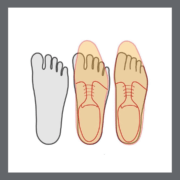
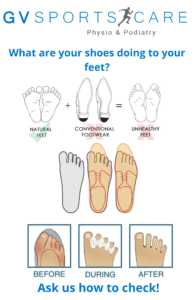
Everyone needs natural foot shape and function to move pain free. Certain features in most modern shoes prevent the foot from functioning as it should.
👣
Building foot and leg strength, increasing mobility within the foot and avoiding particular shoe features can see a bunion return to normal over time.
⏰
Surgery for bunions is necessary in some cases. However, it is important to know that there are treatments and changes that can be utilised to fix or manage the bunion conservatively.
💉

Tom Davey
Podiatrist Shepparton, GV Sportscare